


When the price of fuel becomes a tax problem
What South Africa’s latest inflation numbers mean for businesses – and why SARS is the part of that story most people aren’t talking about yet
Most businesses are already feeling the fuel price squeeze.
Diesel and petrol prices have risen sharply over the past year, and according to the latest figures from Statistics South Africa, released in June 2026, fuel is almost entirely responsible for pushing headline inflation to its highest reading in nearly two years.
Strip fuel out of the picture and underlying inflation has barely moved in months.
So this is, right now, a fuel problem. But for a significant number of South African businesses, it is about to become something else entirely.
How fuel costs create cash flow pressure you can’t always see
The obvious impact of higher fuel prices is at the pump. Fleets cost more to run. Deliveries become more expensive. Generators are costlier to operate.
But the less obvious impact is just as real – and often larger.
Every supplier that relies on transport passes those costs on. Food producers, construction companies, cold chain logistics businesses, retailers – the cost of getting goods from A to B has gone up for everyone, and those increases flow through the supply chain. A business that doesn’t own a single vehicle can still absorb a meaningful fuel-driven cost increase just through its suppliers.
When costs rise faster than income, something has to give.
Most businesses work through a predictable sequence when cash gets tight. They use reserves. They slow down payments to suppliers. They renegotiate credit terms with their bank. And then – when those options run out – they delay payments to SARS.
It usually feels like a short-term decision, thinking that you can catch up the next month. The problem is that SARS doesn’t wait as a creditor does.
What happens when SARS payments are missed
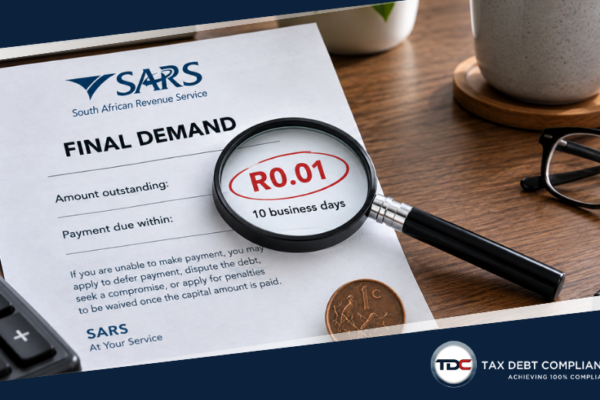
Missing a PAYE or VAT payment triggers an automatic 10% penalty. Interest starts accumulating from day one, and if the payment isn’t made within SARS’s standard timeframe, a final demand follows.
And if that’s ignored, things escalate quickly.
SARS has wide-ranging legal powers to collect what it’s owed. It can instruct a business’s bank to pay funds directly to SARS – without the business’s agreement. It can attach assets and take a business to court and obtain a judgment. In serious cases, it can pursue the liquidation of the business itself.
For directors, there’s an additional layer of risk. Under the Tax Administration Act, a director can be held personally liable for unpaid tax if the failure to pay is linked to
negligence. That means the business’s tax problem can become the director’s personal problem.
None of this happens overnight. But it can happen faster than most people expect – and the financial damage compounds along the way. A debt that starts as a manageable gap can grow significantly once penalties and interest are added.
Why this fuel cycle is different
South Africa has dealt with fuel price volatility before. But a 53,8% year-on-year increase in diesel isn’t normal volatility. It’s a structural shift in operating costs – particularly for transport-heavy industries.
And it’s landing on businesses that are already stretched.
Electricity costs have been rising for years, municipal charges are up, and wages have been climbing. The fuel spike is not the first pressure these businesses have faced – it’s the latest one, arriving at a point where many have already used up their financial cushion.
The warning signs are often visible in the numbers before a business owner recognises the problem themselves:
• Debtors are taking longer to pay
• Suppliers are being paid later
• Management accounts show shrinking margins
• PAYE or VAT submissions are being missed
These aren’t isolated issues. They’re connected, and for accountants and financial advisors who work closely with businesses, they tell a story that goes beyond ordinary cash flow management.
What finance professionals should be watching for
If you work with businesses in transport-intensive industries, or any business that relies on suppliers who do, now is a good time to check in on their statutory payment record.
A business that has consistently met its PAYE and VAT obligations and has recently started missing them isn’t necessarily being reckless. It’s likely under real financial pressure. The question is how bad that pressure is, and what can still be done about it.
A few things worth considering:
• Don’t rely on the balance sheet alone
A business can look healthy on paper while experiencing serious day-to-day cash flow problems. What matters is whether the cash is actually there when statutory payments are due.
• One missed payment is a signal
It doesn’t mean a crisis is inevitable, but it does mean the situation deserves attention. The cost of catching a tax debt problem early is a fraction of the cost of dealing with it once SARS has escalated.
• Directors need to be in the loop
Many smaller businesses leave tax compliance to a financial manager without checking that directors understand the current position. Given the personal liability provisions that apply to directors, this is a risk.
• Some situations need specialist help
Tax debt resolution isn’t the same as tax compliance. Negotiating a deferment arrangement, applying for a debt compromise, or managing an enforcement situation requires a different kind of expertise. Knowing when to bring in a specialist – and doing it early – can make a significant difference to the outcome.
Why early action matters
SARS does have processes for helping businesses that can’t immediately pay what they owe. Payment plans, deferment agreements, and in certain circumstances, compromise settlements – where SARS agrees to accept a reduced amount – are all available options.
But they work best when a business engages before things escalate.
Once SARS has already moved to enforcement, the range of options narrows, the business’s negotiating position weakens, and the work required to find a resolution becomes more complex and more expensive. Tax Debt Compliance has resolved over R260 million in tax debt over nearly a decade of practice, achieving settlements that average around 75% below the original outstanding amount. In the right circumstances, the reduction can be even greater.
But the circumstances that make those outcomes possible – full financial disclosure, a credible proposal, a business still operating – are much easier to create before enforcement begins than after.
The bottom line
Fuel prices are high, operating costs are under pressure, and when businesses can’t meet all their obligations, SARS payments are often the first to be deferred.
That’s understandable, but it carries a risk that’s easy to underestimate.
For business owners and their advisors, the most valuable thing right now is visibility: knowing what the actual SARS position is, understanding what options are still available, and acting before the window on those options closes.
The businesses that come out of this period in the best shape won’t necessarily be those with the strongest balance sheets, but rather those that saw the problem clearly and addressed it early.
If you’re dealing with clients whose tax debt is becoming difficult to manage, a structured conversation can provide direction before critical time is lost. Let’s schedule a meeting.
Source: Statistics South Africa, Consumer Price Index: May 2026 (released 17 June 2026). Tax Administration Act, 2011 (Act 28 of 2011).