When the Payroll Shrinks but the Tax Debt Doesn’t
What South Africa’s employment decline means for businesses still carrying PAYE arrears and why this is the moment to act
South Africa lost 121,000 formal sector jobs in the year to March 2026.
In the first quarter of 2026 alone, 80,000 positions disappeared – a 0,8% contraction that pulled total formal employment to 10,468 million. Gross earnings fell by R43,4 billion in a single quarter. Bonus payments dropped nearly 30%.
These are Statistics South Africa’s own numbers. They tell the story of a labour market under sustained pressure.
But there’s a dimension that rarely makes the headlines: when businesses start cutting jobs, they’re usually already in financial distress. And financial distress – the kind that leads to retrenchments – is the same kind that creates SARS debt.
Why Retrenchments and PAYE Arrears Go Together
By the time a business decides to retrench, it has almost always passed through months of serious cash flow pressure. During that period, it may have been deferring payments it couldn’t comfortably make.
PAYE is frequently one of them.
PAYE is fixed and due monthly, regardless of how trading has gone. When cash is tight, it often becomes the obligation that gets pushed to next month – “We’ll sort it once things improve.”
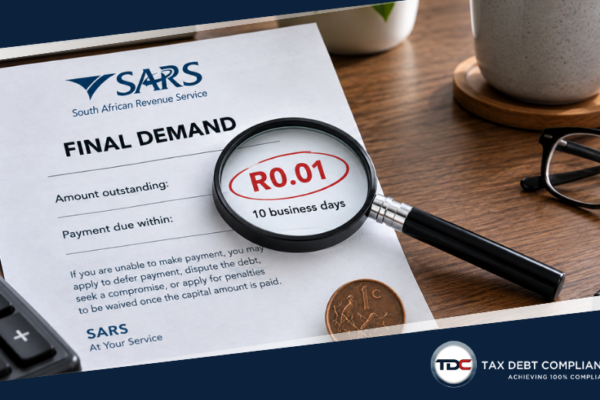
The trouble is that SARS doesn’t wait like a bank creditor does. One missed payment triggers a 10% automatic penalty and interest from day one. If a formal demand follows and is ignored (which is common, because the business is focused on surviving) SARS escalates.
The tools available to SARS are significant:
- It can instruct a bank to transfer funds directly to SARS without the business’s consent
(section 179, Tax Administration Act). - It can attach assets.
- It can obtain court judgment.
- In serious cases, it can pursue liquidation.
For directors, there’s a further layer most don’t anticipate: section 180 of the Tax Administration Act allows SARS to hold directors personally liable for unpaid company tax where the failure is linked to negligence. The business’s PAYE debt can become the director’s personal problem, even after the business is wound down.
The Compounding Problem
What makes PAYE arrears dangerous is how fast they grow.
Miss one payment and catch up the next month? Manageable – a 10% penalty and a month’s interest. Miss three payments because the cash flow problem runs for a quarter? The base debt is triple, penalties have stacked, interest has compounded, and the amount owed when you’re finally ready to address it is meaningfully larger than the original shortfall.
This catches businesses off guard because the growth isn’t visible until it’s already significant. And critically, retrenching staff doesn’t clear it. Cutting headcount reduces future PAYE obligations, but the arrears already accumulated are still outstanding.
Retrenching staff reduces future PAYE obligations. It doesn’t clear the arrears already accumulated.
Severance payments add another wrinkle. Handled incorrectly, they can generate additional tax obligations at exactly the moment a business can least afford them
What to Check Right Now
The 121,000 jobs lost aren’t confined to one sector. Trade lost 40,000. Community services lost 53,000. Transport, electricity, and construction all saw declines. For advisors and accountants with clients across these industries, now is the time to ask:
- What is the current SARS position? A full account statement from SARS, pulled and reconciled properly, will show exactly what is outstanding, what penalties have been applied, and whether any demands have been issued. Many businesses don’t have a clear picture of this, particularly if financial management has been stretched during the crisis period.
- Are submissions up to date? Missed PAYE submissions are a separate issue from missed payments. Even if the money wasn’t there, the submission should still have been made. Failures to submit are treated differently from failures to pay, and can complicate any subsequent resolution process.
- Do the directors understand the personal liability dimension? In smaller and mid-sized businesses, the operational pressure of managing a retrenchment process can mean that directors are not fully across the SARS compliance position. Given that section 180 liability can follow directors personally, this is worth addressing directly and soon.
- Is the current debt manageable through normal cash flow? A business that has retrenched and is now on firmer footing may be able to address PAYE arrears through a structured payment arrangement with SARS. That is an achievable outcome, but it requires formal engagement, and it works best when initiated before SARS has moved to enforcement.
Options Exist, But Timing Is Everything
SARS does negotiate. Payment arrangements, formal deferments, and in serious cases, tax debt compromise are all real options. But they work best before enforcement begins, not after. Once SARS moves – bank accounts approached, assets attached, legal proceedings initiated – the negotiating position deteriorates and the range of solutions narrows.
For businesses that have retrenched and stabilised, this is the right moment. The operational pressure has passed and cash flow is recovering. Addressing the SARS position now, before SARS moves on its own timeline, keeps the widest range of options open.
Final Thoughts
South Africa lost 121,000 formal sector jobs last year. Behind each of those numbers is a business that went through real distress – and in many, PAYE arrears accumulated quietly during that period, compounding while attention was elsewhere.
The retrenchments are done. But the tax debt doesn’t leave with the departing staff.
Tax Debt Compliance has managed over R300 million in tax debt over the past decade, achieving settlements that average around 75% below the original outstanding amount, with the largest single reduction reaching 97%. Those outcomes are achievable, but they depend on timing. The earlier a business engages, the more options remain on the table.
If you’re working with clients whose SARS position has become a concern alongside broader financial pressure, a structured conversation before the window narrows further is a wise next step. Let’s schedule a meeting.