

Is My Tax Debt Big Enough to Be on SARS’ Radar?
A one-cent demand just answered that question for everyone
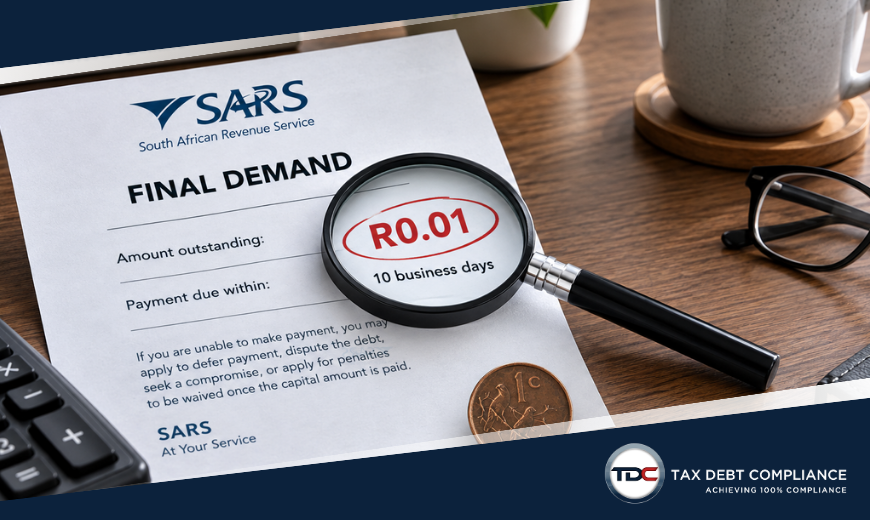
Last month, a South African taxpayer received a final demand from SARS. The outstanding amount? One cent.
R0.01. SARS instructed the taxpayer to settle the balance within 10 business days, and noted that they could apply to defer payment, dispute the debt, seek a compromise, or apply for penalties to be waived once the capital amount was paid – standard final-demand language, applied to a single cent.
The story was reported by Moneyweb and picked up widely. The taxpayer believed the letter was automatically generated and questioned whether anyone at SARS had actually reviewed it before it went out.
That’s almost certainly the right assumption. And it answers the question that many business owners and directors ask – often quietly, often hopefully – when they know they have an outstanding SARS debt: Is it big enough for them to actually come after me?
The answer, as a one-cent final demand makes clear, is: there is no threshold.
SARS Does Not Have a Minimum
There is no official minimum amount below which SARS will not pursue collection. No floor. No de minimis rule. No policy that says “we only act on debts above R10,000” or any other figure.
Moneyweb captured this plainly: even very small debts can set SARS’s collection powers in motion.
This matters because many people carry a working assumption (often unspoken and rarely examined) that a “small” tax debt is a low-priority matter; that SARS is busy with bigger fish; that a few thousand rand in PAYE arrears, or a disputed VAT amount sitting unresolved, isn’t going to attract serious attention.
The one-cent demand is a useful corrective. If SARS’s automated systems will generate a final demand for R0.01, they will certainly generate one for R5,000. Or R50,000. Or R500,000.
The size of the debt may change the consequences, but it does not change whether SARS acts.
What Non-Compliance Actually Costs You
The real danger of even a small outstanding SARS amount isn’t the demand letter, but what the non-compliance status that comes with it can do to a business.
A second case in the Moneyweb reporting makes this point sharply. A taxpayer expecting a R323,000 refund discovered it had been blocked – not because of a large debt or a dispute, but because SARS regarded them as R50 behind on their PAYE profile. Neither the taxpayer’s accountant nor a SARS branch consultant could initially explain why the refund had been withheld.
A R323,000 refund. Blocked by a R50 shortfall.
This is not an anomaly. It is simply how the system works. SARS’s compliance status is binary: either you are compliant, or you are not. A R50 outstanding amount and a R500,000 outstanding amount can produce the same status on your taxpayer profile – “non-compliant” – with many of the same downstream consequences:
- Refunds withheld. Any amounts SARS owes you can be offset or held until compliance is restored.
- Tax clearance certificates blocked. Required for government tenders, certain contracts, and a wide range of commercial and regulatory purposes.
- Export permits at risk. A 2022 case cited by Moneyweb showed that a disputed debt – not even a confirmed one – led to loss of export permits once SARS issued a final demand during the dispute process.
- Bank credit facilities affected. Some lenders require current tax clearance as a condition of facility renewal or drawdown.
- Government funding blocked. Grants, incentive programmes, and government-backed funding typically require compliance as a precondition.
The Automated Machine
Part of what makes this counterintuitive is the assumption that someone at SARS is making a deliberate decision.
For routine collection activity, that’s largely not how it works. SARS’s systems are increasingly automated. Assessments are generated, demands are issued, and escalations are triggered. The machine doesn’t weigh whether R0.01 is worth chasing; it simply follows the process.
SARS acknowledged as far back as 2013 that it had mistakenly sent final demands rather than reminders to some taxpayers. But the solution to that kind of error is engagement, not silence. A taxpayer who receives any SARS correspondence and ignores it risks the automated process moving to the next stage without any human intervention.
If a debt remains unpaid, SARS can instruct a third party, such as a bank or employer, to recover money directly without first obtaining a court order. That’s not a last resort. It’s a standard tool, triggered automatically once the process reaches that stage.
For Larger Debts, the Logic Is the Same – Just With Higher Stakes
The one-cent story is notable because of its absurdity. But for business owners and directors sitting on material tax debt – tens of thousands, hundreds of thousands, or more – the underlying message is identical, just with far higher stakes.
If SARS acts on R0.01, it will act on R500,000. The question is not whether SARS will eventually move on a significant outstanding debt. The question is only when, and what position you’re in when it does.
A business with a substantial SARS debt that is currently not in active enforcement has a window. It’s a window to engage – to approach SARS with a structured proposal, to explore a payment arrangement or a compromise application, to put a resolution plan in place before SARS’s systems trigger the next stage of collection action.
That window doesn’t stay open indefinitely. Once SARS issues a final demand, or moves to third-party appointments against bank accounts, or takes the matter to court, the dynamics change. The negotiating position shifts. The costs increase. The options narrow.
What to Do If You Have an Outstanding Amount
Whether the amount is fifty rand or five million rand, the practical response is the same: understand the position, and address it.
For small amounts – a minor shortfall, a rounding difference, a disputed assessment – the priority is getting the compliance status resolved before it costs you something disproportionate, like a blocked refund or a failed tender application.
For larger amounts, the priority is engaging with a clear strategy before SARS moves. That means understanding what SARS has on record, assessing what options are available, and putting a structured plan in place
Tax Debt Compliance has managed over R300 million in tax debt over nearly a decade, achieving settlements that average around 76% below the original outstanding amount – with the largest single reduction reaching 97%.
Don’t wait for SARS to act first. If you have an outstanding SARS balance (of any size) and you’re not sure what the implications are or what options you have, let’s have that conversation now.